CATCH Canine Trainers Academy Blog

Tip of the Day – Don’t Ruin Your Recall

Recall = Dog Trainer’s Term for “Coming When Called”

Use a long line to ensure success and safety when you first start practicing in big open spaces. This is a beautiful recall. "Good Girl!"

The Myth: IF your dog ignores you when you first call him to come, and continues to ignore you, or even worse – runs AWAY from you – THEN when you do finally re-unite with him, you must really scold him so he knows better for next time.  (Oh no!  See below.)

The Real Deal: If you punish your dog when you re-unite with him you’ll find it even harder to get him to come next time.  You’ll lose trust.  Late corrections are confusing relationship-ruiners.  Another way to describe this common mistake is: You’ll ruin your recall if you call your dog to come and he ends up in a situation he doesn’t like.

Here’s an example I see all the time: An owner calls her dog who is joyfully running free in the park and then when the dog arrives he is immediately leashed, followed by leaving.  Ending recalls with negative consequences will lead to lack of trust and goodbye recall.  Do it just a few times and  it won’t be long before you see one of three dreaded responses each time you call your dog:

  1. He pays attention but gives you “The Look.” The look is when your dog stays right where he is and stares directly at you with an inquisitive expression which can best be interpreted as “Come?  Now?  For what?  Is this the recall that SUCKS or the one that ends in chicken treats?  If the latter, show me the chicken, then we’ll talk.”
  2. He completely ignores you as if he doesn’t hear you at all (and he may not if he’s tuned into a heavy distraction).  Look for an ear twitch to know if he heard you at all.  You’d rather he didn’t – then at least you know he didn’t consciously ignore you.
  3. He runs in the OTHER direction. This is the worst of all – the ultimate statement in lack of trust and connection.

#1 above is where you can only get a recall if you “show me the money” first.  You  have to bribe your dog.  It’s not a situation where the dog is trained or reliable.  You’re trained!

#2 is when you’re completely irrelevant and you don’t have the dog’s focus.  No training could take place in this situation (even if you wanted to) because you are not in control of the primary motivator – which is the environment and its distractions.

#3 is what it is.  Your dog knows exactly what’s going on – he’s learned that the cue of you calling means to move further away.  Time to change the cue and start the recall training from the ground up.  The good news is that with a new cue, you can get this right!

The Wrap: Never end a recall with something your dog won’t like.  DO just the opposite, end most recalls with a generous, awesome reward upon your dog’s arrival – ESPECIALLY during early training of this behavior.  Sounds obvious right?  You’re saying you would never end a recall with a punishment.  Ha!  Are you sure?  Think about your immediate response next time your dog comes to you when called.  Was it something she liked?


Have you always loved dogs and wanted to learn professional training skills?  You’ve found the right place!


To stay in the know on dogs
Follow CATCH on Twitter
Like Our Facebook Page

How to Teach Puppies to Stop Biting – The Hand Block

Ouch! How do I get my puppy to stop biting me?

One great method for teaching puppies not to bite is to use a hand block when you are playing games with toys.  This is a way for your puppy to learn about self-control and bite inhibition.  The goal is for the pup to learn that teeth on toys is acceptable and fun, whereas teeth on skin is NOT allowed and will end all fun immediately.

Select a toy that is small or “scrunchy” so that you can easily hide it behind your two hands when the time comes.  A tennis ball, small rope bone, small stuffed animal, or small squeaker – all will work great.  Once you have a dog who loves to play with a toy, you are ready to go!  Get the dog excited about the toy by letting him chase it and pounce at it.  Then, suddenly pick up the toy and hide it behind your two hands with the back of your hands facing the dog.  Watch the video to see what I mean.

When you hand block the toy, it is critical that you keep your hands out right in front of the dog to give him a choice.  He can either bite your hands, or stand back for a second and wait.  If he bites your hands you will NOT continue the game.  You can completely ignore him and keep your hands still, right where they are, or you can stand up and turn away for a few seconds.  I like to completely ignore, but some people find their pups bite too hard for that.  If you did ignore the biting, you will notice that at some point the pup stops and stands back.  Watch for that split second when the pup stops biting and moves back.  NOW, praise and immediately start moving the toy around on the floor again as a play reward!  You are rewarding the instant the pup decides to stand back and wait rather than jump at your hands and bite them.

Repeat this over and over, making it NO fun if the dog bites or jumps at you (no play), and LOTS of fun when the dog shows self control by waiting for you each time you do a hand block (the reward for the pup standing back is another chance to chase the toy, tug, or fetch).  Notice how the Westie in the video never touches his teeth to my skin.  Watch him carefully when I hand block.  See how he turns his mouth away  right when I do it?  He didn’t start out that way.  He learned it!

A Rare Mexican Village Where the Training is Garbage

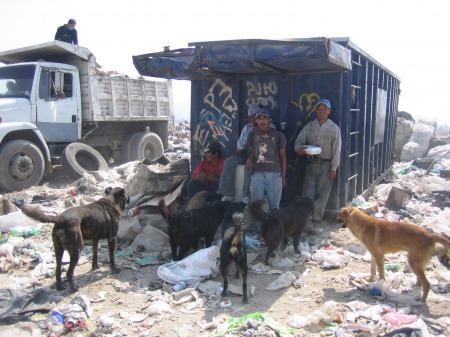
It’s sunny, hot, dry, and dusty.  Toxic air burns your nose and throat.  Some people here are scary and don’t want you around.  But this place is too fascinating to leave.  You squint your eyes and survey the scene.  1,000 free-roaming dogs in a square mile.  This is the garbage dump of Mexico City.

“I make my living here, and do quite well, thank you.” Studying dogs in this environment with canine ethologist Dr. Ray Coppinger was incredible.

I learned so much in this mesa of refuse.  About dogs and people.  Here’s one storyline that struck me.  It relates to every dog owner.  It’s about dogs coming when called.  We all want our dogs to come when called.  Right away.  You’ve heard me say the two most important factors that determine a dog’s response are: 1) your relationship, and 2) the training.  We’ll come back to this concept in future articles and episodes, I promise.  But today I’m not going into details because the video tells it all.

My colleague and I came upon a group of men who live and work in the dump.  Yes, both.  We were interested in finding out if any of them perceive themselves as “owners” of any particular dogs.  Turns out some of them do see themselves as owners, but in a VERY loose way compared to what anyone reading this on a computer screen is used to.  We asked the men which dogs were “theirs.”  (We were surrounded by hundreds of dogs.)  So, they showed us.  By calling them.

The relationship?  I believe this perfect recall is a result of the same natural relationship that the very first dogs had with humankind.  The sharing of food.  Yes.  That’s it.  That’s all it is.  There’s not a whole lot of praise and effusive love in this “training.”  If you look carefully you’ll notice when the dogs arrive they won’t even let the men touch them.

The training?  Simple.  Just like in our positive reinforcement obedience classes.  The signals the men use to call the dogs have been associated with a reward.  In this case, though, it’s not being done for training purposes.  These men don’t share THEIR food with the dogs.  (You can see none of them are rushing to open the meal boxes we presented in exchange for their interview.)  No, I don’t believe they share their own food much at all.  But the men are dump diggers.  They sort through heaps of trash with gigantic long-toothed rakes.  And sometimes they unearth… meat.  Yes, more than once I saw a huge rake flash its teeth in the sun, then get thrust into a deep pile of trash, and come up with a stabbed hunk of carcass.  Cattle?  Pig?  No matter.  The meat was in giant plastic bags that the men pulled from the pile and ripped open.  Then the dogs were called.  And they came.  Just like in training class…

…except they don’t Sit.


Learn more about the Mexico City Dump Dogs in the CATCH Press section.

Your Dog Reveals Your Character (and Affects Your Love Life)

The greatness of a nation and its moral progress can be judged by the way its animals are treated.
–Mahatma Ghandi (1869 – 1948)

One of my dearest female friends must have had this quote in mind when she called me one morning.  She had moved across the country several months ago.  I didn’t get to hear from her too often.  She moved in search of the new energy and inspiration that a total change of scenery can bring.  And she was still searching for her true love.  She hadn’t been in a long relationship with a guy for a while.

I was checking my voice mail and heard this interesting message,

“David,  I met this new guy, I might really like him.  He has a sweet, sweet dog.  I want to ask you about some things he does with his dog.”

“Cool,” I thought.  “She met a guy.  Awesome.  She probably wants to get some training advice for him.”

Nope.  I called her back and that wasn’t it.  She thought this guy might be really cool.  Might be a long-term thing.  And she KNEW that she could learn more about his character by looking at the way he treated his dog.  So she wanted my opinion.  She saw him practicing some interesting rituals and wasn’t sure what to think.

This dog is licking its chops, waiting for a cue to eat.

“This guy I’m dating always eats dinner before he lets his dog eat,” she told me.  “He prepares her food in a bowl and then leaves it on the counter.   Then he eats his dinner while she waits.  When he’s done, before his dog gets to eat, he asks her to lie down and stay.  Then he lowers her bowl to the floor, makes her wait a few seconds, and releases her to eat on his command.”

“Is that normal?” she then wondered aloud before I got a word in.

“It’s what his trainer told him to do,” was the next thought she couldn’t keep inside.

“Don’t worry, sweet friend of mine,” I’m thinking (I can tell she really wants this guy to be cool), “that’s not bad, not bad at all.”

And I told her so, “That sounds like typical ‘make sure you’re the pack leader’ type of stuff,” I said.  “Maybe a little overboard as far as his dog being resigned to drool desperately while she smells her meal on the counter the whole time your man eats, but that’s nothing crazy.  There are some real, logical benefits to what his trainer told him.  He is teaching her: 1) patience, 2) self-control, and 3) that he controls the resources and he’s only going to share his resource with a dog that can be calm, cool, and collected.”

“So you don’t think it’s mean to make her wait to eat?” she asked.

“It’s a bit of a tough love approach,” I said, “but no, it’s not mean.  I think having the dog do a Stay before being released to the food bowl is a great practice.  I’m just not sure he needs to eat first.  That part could be a bit far-fetched, more of a myth.”

“Um-hm,” she said, listening intently on the other end of the phone.

“Let me ask you this,” I said.  “Is she a good dog?”

“She’s a GREAT dog,” my friend quickly replied.

“Is he sweet with her?”

SO sweet with her.  They are great together.  He never yells at her or anything like that.  He just wants her to be a really good dog so he follows the advice of his trainer.  He took her to a training school where they used rewards to teach her and she listens really well.  He practiced a lot with her.  She’s great.”

“Sounds good, sweetie,” I said, relieved.  “Go on another date with this guy.”

~

6 months later…

What a great couple.  They’re totally in love.  Great guy.  And the dog, she’s wonderful.  Turns out he saved her life.  Adopted her when she had heartworm, paid for the treatment.  Watched over her day and night during the intense healing process.  After two worm-killing injections, all the dog was allowed to do for 12 weeks was stay inside or go on very calm walks.  If her heart rate went up too high, the little pieces of dead heartworm in her bloodstream would move into vessels where they would get stuck and kill her.  So he had to be extremely disciplined and caring when he first brought her home.  And then for another twelve weeks.  His dog made it through.  She is forever grateful.  And my friend may be forever grateful that she met this beautiful man.

~

1.5 years after this story was originally written…

These two are happily married.  One of the best weddings I’ve ever been to!

Who is the Leader? Defining Factor #3: Timing

If you want to be the leader of your pack, you must have great TIMING when you communicate with your dog.

If your timing is not good, dogs can’t understand you.
Know this: dogs that can’t understand you will TUNE YOU OUT.  Follow this simple logic:

1. The only way your dog can do what you want is if he understands what you want.

2. For your dog to understand what you want, your message must make PERFECT sense to him.

3. And in order for your message to make sense, your timing when communicating praise or disappointment must be perfectly in sync with your dog’s actions.

One of the best sum-up phrases I’ve heard to describe this concept is: Dog Training is letting a dog know whether you like or dislike a behavior WHILE it is happening.

Most dog owners botch this simple concept.  In many ways.  The good news is it’s easy to get better at this and you will see your leadership status rise. Let’s look at a few examples that will help you sharpen your canine communication.

Example 1: Praise and reward on time. Let’s say you want to teach your dog to walk politely on leash. You’d like to see him keep the leash loose and pay attention to where you are (as opposed to just launching down the street as if you don’t exist on the other end).  Most owners miss opportunities to let the dog know which behaviors they like on leash.  Here’s what you do: during the exact instant when your dog is: 1) keeping the leash loose, or 2) looking at you – PRAISE!  Reward!

Rewards can be chest or belly scratches, playing with a toy, food treats, chase games – whatever works.  The more varied the rewards the better.  This works especially well with young pups who haven’t yet learned to pull on leash.

Example 2: If you don’t like a behavior, interrupt or correct on time.  Your dog is about to take food from your coffee table. The best time to say “No” or “Leave It” is RIGHT BEFORE SHE STEALS the FOOD – when she’s in the “stalking” act.  How do you know your dog is about to steal the food?  Look at her!  She’s sniffing it from 1 foot away, now 6 inches, now…  What are you waiting for?  Tell her now – when you know she’s beginning the sequence of the unwanted behavior.

If you wait until she has eaten some food – you’re WAY too late.  The payoff for the stealing is extremely rewarding.  Yum, lips are being licked.  Your dog will repeat this behavior – guaranteed.

Another bad side effect of this:  if you’ve tried some kind of correction after she’s eaten the stolen goods – you’ve now rendered your communication meaningless.  She’s learning that what you say means nothing because it is AFTER the BEHAVIOR already happened.  Late corrections are not only confusing and damaging to your relationship, you’re actually teaching your dog NOT to listen to you because you make no sense.

Want another common example under the same category?  This one is brutal and it still shocks me that there are people out there who think this works.  If you scold your dog for a pee or poop accident that you found AFTER it happened – you are playing the fool. Your late correction make absolutely no sense to your dog.  Don’t believe me?

Here’s what you sound like to yourself when you do this: “Dog, don’t you ever urinate or poop in this spot again!”

Here’s what you sound like to your dog: “Dog, I am so angry but how would you know why!? Sometimes when I stand near a puddle of pee or a poop I just act like an angry idiot!  Isn’t this confusing and weird! Isn’t it! There’s no reason for you to think of me as a clear communicator!  NO REASON!!!  I just get ANGRY sometimes around pee or poop.  If you see me near the stuff, look submissive (guilty in human terms).  That might keep me from getting really mad.”

Do you see the point?  Your dog can learn that you get angry when there’s pee or poop around but that doesn’t teach her anything about the ACTION of peeing or pooping or WHERE to do it. TIMING!

Example 3: You reward your dog for behaviors that aren’t good, rather than for specific behaviors that you like. First of all,  remember that rewarding your dog all the time renders rewards meaningless.

Second of all, rewarding your dog after an undesirable behavior will make that behavior stronger. Yikes.  This one is common.  I see it all the time with puppy parents.  They continue to play with their puppy, even when the puppy is biting their hands and arms hard, and in out-of-control fashion.  If you keep having fun with a pup who is playing rudely, you are rewarding this style of play.  Timing!  Teach your pup that he must take all of his feisty energy out on the toy you are playing with, NOT on your skin or clothing.  If your pup insists on biting YOU – don’t continue the game.

Here’s a great tip: for very mouthy pups, get long toys that keep your hands and arms out of the picture while you stand up!  For a homemade version, tie together a bunch of old socks or a t-shirt. If you use socks, you can drop a ball in the bottom sock for added effect.  Let your pup chase and grab that toy while you stand up or sit in a chair, well out of range of those needle teeth.

The Wrap: I can’t tell you how many times I’ve walked into someone’s home and within five minutes the dog will listen to me more readily than they have ever listened to their owner.  People remark on it all the time.  Is it because I use some kind of mystical dog telepathy?  Nope.  There’s no such thing.  It’s because I am a CLEAR COMMUNICATOR.  Dogs love it!  They can see right away that they’ll be able to understand which behaviors I like and which behaviors I don’t.  It’s timing. It makes you a leader.  Focus on your timing, and you’ll suddenly see your dog start to understand you.

Who is the Leader? Defining Factor #2

The leader is the one in control of the resources.  Some dogs need to be in control of everything.  Others are totally passive.  Most are somewhere in between.  Either way, you can be sure your dog knows exactly who controls the resources.

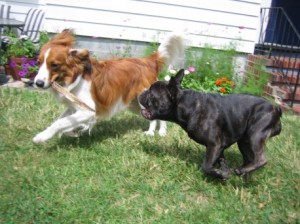
Two Dogs Playfully Decide Who Will Control the Coveted Stick. Dog-to-Dog Behavior in Relation to Resource Control is Similar to Dog-Human.

What do I mean by resources?  I mean the things that matter most to your dog.  And every dog is different.

I took a survey of 1 million dogs, asking them which resources were most important to them, here’s what they said:

  • Food
  • Toys
  • Resting Areas
  • Water
  • Territory
  • Entrances/Exits
  • Access to other dogs
  • People (and their attention)
  • Whatever all the other dogs want

(No, I did not really survey dogs.  They can’t talk or write.  But this is pretty close to what they would have said.)

Ok, so here’s the deal: If your dog doesn’t appreciate that you control the resources, he won’t see you as a leader.  How does this happen?

Example 1 – The lowest level of leadership: You give everything away for free. Your dog gets so much attention, food, access to preferred resting areas, etc that he has absolutely no appreciation for any of it.  He doesn’t believe you control anything.  In fact, he thinks you are his slave.  You have no expectation of good behavior from him before you give him anything, and therefore he doesn’t bother listening to a word you say.

(Unless the words are “Here shmoopy, have a marrow bone.”)

Example 2 – The Illusion of Leadership. You are eating a sandwich.  You think you’re in control of it.  But you’re not.  Why?  Because all your dog has to do is come over and perform a certain behavior that works every time.  You’ll give up a piece of your meal, she’s certain.  This could be begging, barking, nudging, jumping – whatever – your dog knows it works.  If somehow it doesn’t work the first time, she escalates to a more obnoxious behavior (bark louder, nudge harder).  Then you give in.  She doesn’t dream for one moment that the item is yours.  You’re just holding it for her.

Example 3 – Actual Leadership. You don’t share everything.  Sometimes you keep certain things all to yourself.  Like your bed.  Or your meals.  Sometimes you share, but sometimes you say NO.  And when you say no, you stick with your decision.  This gains you respect, teaches your dog patience.  This builds frustration tolerance (don’t own a dog without it).  Teaching your dog to accept limits and boundaries makes you a leader.

This doesn’t mean you can’t share your bed with your dog, of course you can.  But if you ask your dog to get off, does he get off?  If so – wonderful, he respects your control over this resting area.  That’s a sign of your leadership.  It’s tough to be a leader without control over your own bed. (!)

The Wrap: Please DO share generously with your dogs, but not everything, not all the time.  And when you share, make it clear that it’s YOUR choice.  Remember leaders initiate, followers react.  Only share with a dog who is being polite.  A great example is to have your dog lie down quietly while you prepare their food, then YOU release them to eat it once you place it on the floor.  This shows that you control the resources and you initiate the decisions.

Gone in a Flash

It was late in the evening. Middle of summer.  Weeknight.  Thunderstorms pounded outside.  I just got in from teaching classes, exhausted from a full day of running around the city.  No one else was home.  Finally, time to chill for an hour or two before bed.  I kicked back on my couch with remote in hand, Yankees on the tube.  Just as I gulped my first swig of root beer my phone rang.  I looked at the time – 10:45 pm.  I looked at the phone number.  It was a New York City cell, which means client.  “This late?” I thought.  Better let it go to voice mail.  Who knows what could be on the other end of that line.

I let myself drift back into the ballgame.  Two balls and a strike.  One out, runner on first.  “Beep, Beep, Beep.”   Oh, that voice mail.  It’s waiting for me.  I casually pick up the phone and dial in my password while focusing on Jeter at the plate.  But then my mind gets pulled into the phone.  I hear the sound of distress.  It’s a familiar young woman’s voice, she’s crying, worried, desperate.

“David, it’s Monica, your client with Kio the Italian Greyhound, I’m sorry to call you right now but I don’t know what else to do.”

I can tell she is calling from her cell phone and she is outside.  I look out my window and it’s pouring.  Her high-pitched, scared voice made me sit up and listen as the message continued.

“I was with Kio in the Carl Shurz dog park about a half hour ago.  He was having a great time playing like he always does and then suddenly there was a flash of lightning and a VERY loud crack of thunder.  Kio got so scared that he shot to the edge of the park and jumped RIGHT over the fence.  It happened so fast I had no time to react.  I CAN’T FIND HIM.  I don’t know what to do.  Please call me if you get this.  I just don’t know what to do.”

I took a deep breath.  I felt so bad for her.  I could picture that little dog bound out of the dog run and disappear like a bolt of lightning himself.  Another deep breath.  Then I thought about the situation and what I could do, if anything.  I knew what dog park they were in.  Low fence.  Close to roads.  “Stay away from traffic, Kio,” I thought to myself.  There was no way I could help her look for him, I had already driven all the way back to Jersey.

I felt so sorry for Monica who adored her gentle dog beyond all measure.  Poor Monica, who was a great client.  She practiced everything I taught her and did a good job of it, too.  Kio had a great recall, I knew that for a fact.  But, he was probably so panicked from the storm that he was ignoring her calls.  Or, when he heard that thunder, he ran so far so fast that he was too distant to hear Monica crying out his name.  I pictured this sweet, fragile Italian Greyhound huddled under some bushes, shaking, uncertain of what to do next.  Then I remembered that Monica was waiting for a voice of reassurance.  I picked up the phone and called her back.

“Monica, it’s David Muriello, is Kio still missing?”

“Yes, I’ve been searching all over the park, but I can’t find him anywhere.”  Her voice was so sad.  I could picture the tears and rain on her face.

“Okay, tell me again what happened,” I said.  And she did.  She told me she’d been searching all over the park for a half hour.  No dog.  She moved on to the adjacent streets and was asking strangers if they’d seen an Italian Greyhound running loose.  Poor Monica.  Calling out her dog’s name at the top of her lungs, in the middle of the night, on the streets of New York.  Believe me, when you lose your dog, even though you want to find him more than anything, it’s embarrassing and scary to be wandering about, shouting his name out over and over and over.  The longer you do it, the more uncomfortable it gets.  The more you think about the worst.  Did he get hit by a car?  Is he hurt somewhere?  Did someone steal him?  Is he looking for me?

“Listen,” I told her resolutely, “the one thing I know is that Kio is looking for you.  If he hears you or smells you he will come to you.  Keep calling his name, loud and clear.  And keep asking around to anyone you see, ask if they’ve seen him.  Give them all your cell number.”

“Okay,” she said, sounding glad to hear words of support.  “That’s what I’ve been doing.  No one has seen him yet.”

“Keep going,” I said.  I suggested she get at least one friend out there with her and gave her a few more words of reassurance.  Then I told her to call me back if she needs help or has an update.

We hung up and I went back to baseball.  There was nothing else I could do for now.

Innings went by.  The game wasn’t as much fun as it was before.  I went from sitting on the couch to laying.  My eyes started closing.  About an hour later the phone rang and I grabbed it.  It was Monica’s cell number on the caller ID.

“Hi,” I said quickly, “Did you find him?”

“Yes, I’ve got him.” I could hear her smile.  And I smiled, too.  I pictured her clutching him lovingly (and tightly) in one arm while holding the phone in the other.

“Yessss!  That’s awesome,” I said, “How did you find him?”

“Well, I started going into all the local bars and restaurants, asking everyone if they’d seen him.”

“Uh, huh,” I said, intrigued.

“And when I got to 1st Avenue some people told me they DID see him.”

“1st Avenue?” I thought to myself, “Whoah, that’s two full avenues away from the park.  This dog did some street crossing. Yikes.

“They told me they saw Kio with another dog and a homeless man.”

“Huuhh,” I sucked in a breath of disbelief.  My jaw dropped as I listened to her continue.

“I went back outside to continue searching.  Right when I looked down the street I saw a homeless man with a shopping cart and a dog.  I ran towards them to ask about Kio, but before I could say a word I saw him sitting next to the other dog, like a happy little prince in the basket of the man’s cart.”

“Did the guy give Kio back to you without a fuss?” I asked, amazed.

“Oh yeah,” she said.  “He was as nice as could be.”

“Oh my god,” I exclaimed, “Little Kio saw that street dog and said help me! and he did!  What a smart little guy, he ran right to the street wise dog who had the street wise owner and the three of them had everything under control.  That homeless guy probably just scooped Kio up in stride, had a few sweet words, and kept on strolling.”

“I know,” Monica said, “I can’t believe it.  I’m just so happy I got him back.”

“Me too,” I said, “Sleep tight, Monica.”

“Thanks,” she said, “I will.”

How to Housetrain Me. Love, Your Puppy (or Newly Adopted Dog) – Rule #2

Great to see you again! Read my continuing letter below.

Dear Human Parent,

Thanks so much for listening to me about this whole house training thing. I’m so grateful for your attention and I promise I’ll get it right if you follow these SIX SIMPLE RULES.

Just be consistent and give me some time to figure it all out.  It’s going to be so much fun to learn exactly where I’m supposed to potty so nobody will get pissed off.  (Ha! Who said puppies don’t have a great sense of humor?)

Okay, now that we got Rule #1 down in the last post, I’m ready to tell you about…

RULE #2:

Don’t wait until it’s too late.  Take me to “my spot” as often as Ineed to go.

All of us pups have different size bladders and different digestive systems. That means some of us pee and poop more often than others.  As a young pup, I can tell you straight away that I’m going to pee A LOT!  Sometimes I’ll even pee within ten minutes of my last pee.  (I know, it’s a bummer, but there’s not much I can do about it.)

Let me warn you now – I WILL NOT be able to tell you when I have to potty in the beginning stages of house training.  But, if you pay attention to how often I go, you’ll see I have pretty consistent patterns.  You have a better memory than I do, so please keep track of when I go.  And take note that after I eat or drink, something’s going to come out sooner than later!

Once you have a sense of my patterns, all you have to do is get me to “my spot” as often as I need to go!  If you’re training me to go outside, that means take me to the yard or for a walk.  If you’re training me to go on wee pads, then think of my exercise pen with the pad as the yard, and put me in my pen (“the yard”) as often as I need to go.

The bottom line: if you take me to my spot to empty my tank as frequently as needed, I’ll never make mistakes anywhere else. If you wait until it’s too late, please don’t blame me! I won’t know any better until you get very consistent with showing me what to do.

The great news is that once I go to the same spot, on the same type of surface, over and over, I’ll come to prefer that as my favorite spot!  That’s why it’s so important to be consistent.  I can’t develop a preferred spot if I end up making “mistakes” on the wrong surfaces, or many different surfaces. So please follow this Rule #2 and help me out!

Here are some things I know about myself that will help YOU out. Common times that I will have to potty are:

  • first thing in the morning
  • after I eat
  • after I drink
  • right after a nap
  • after a big chew session
  • after (or right in the middle of) a big play session/running around
  • after I come out of my den/pen

Here are some more helpful facts about me.  If you see me doing one of these, good chance I have to potty. Quick – get me to my spot!

  • sniffing the ground, especially sniffing in circular patterns
  • walking towards, on, or around “my spot” (including the door to outside)
  • suddenly walking away from an activity I was engaged in – as if something unseen has caught my attention
  • panting
  • whining
  • squatting (uh-oh, that could be too late, sorry but you’ve got to beat me to it!)

Okay, now that we’ve discussed the first two rules for house training, I’m feeling really good about our chances for success.  Let’s talk again soon, I’ll tell you about Rule #3 then (wag, wag)…

How to Housetrain Me. Love, Your Puppy (or Newly Adopted Dog) – Rule #1

Hi! Please read this letter, I worked hard on it. (Have you ever tried writing without thumbs?!)

Dear Human Parent,

I love you and I’m so happy to be here with you.  This is going to be a great time, but can we please get on the same page with one thing right away?  It will be so much more fun for both of us if you teach me EXACTLY where you want me to potty.

Please follow these SIX SIMPLE RULES and then I’ll know where to pee and poop! Just be consistent and give me some time to figure it all out.

Today, we’ll start with…

RULE 1:

When you’re not watching me, please keep me in an area where I can’t make any mistakes. I don’t want to screw up, but if you let me walk around anywhere in the house I just know I’ll pee and poop all over.  I can’t think of a single reason not to.

~

By the way, I don’t mind hanging out in my own special den.  A crate, a pen, or a small room is cool by me as long as you show me that it’s a safe, relaxing place.  It wouldn’t hurt if you made the space extra fun, especially in the beginning while I’m getting used to it.  If it’s somewhere that treats and chewies are regularly found, I’m sure to like it!  And please give me plenty of exercise in between my time relaxing.  Do that, and  let me experience separation from you very gradually at first.  Then I’m totally cool with it all, promise.

If you want me to use a wee pad, make my special den space JUST big enough to have a wee pad and a small separate area for me to hang out in.  Make sure the separate floor space has a VERY different surface texture than the pad!  I’ve heard those exercise pens you get in pet stores are perfect for creating a den with a wee pad.  They can even be set up so you surround the pad on all three sides with the walls.  This makes it much easier for me to hit the target.  Believe me, that’s great!  Any help you give to make this as easy as possible for me is appreciated.  The idea of knowing EXACTLY where to pee and poop takes some time for me to get used to and I just can’t figure it out on my own.

If you prefer to skip the wee pads, that’s just fine by me. But, if you want me to hold it in until you take me out of the den, then please make my den space smaller.  Naturally, I prefer to keep a small space clean.  If you give me a lot of space, believe me, I’ll just go poop over there and nap over here.  I can’t help it.  That just seems to work fine for me.  Oh, and don’t forget not to leave me in there too long – I can’t hold it forever you know!  And I do like to balance my alone time with fun time!

Thanks so much for listening.  You seem like a great owner.  I’m excited about this relationship!

The Housetraining Myth – Why Scolding Doesn’t Work

The Myth:  In order to housetrain a puppy, you must show him repeatedly and with authority that peeing or pooping in the WRONG spot will lead to being scolded. (INCORRECT!)

The Real Deal: Housetraining a puppy is setting him up to go in the RIGHT spot, over and over.  For every time you catch and interrupt your dog while he is soiling the wrong place, you should have at least 25 instances of him going in the RIGHT place.  In other words, accidents should be RARE.

Whose job is it to get your pup to go in the right place? Yours.  You must set your dog up for success.  That’s why scolding doesn’t work – because it doesn’t lead to rewarding experiences.  Remember, rewards drive behavior.  If it works for the dog, he’ll repeat it.

Very soon I’ll post a complete set of can’t-miss housetraining instructions.  In the meantime, read The Real Deal above again, and again.  The Myth regarding scolding could not be more wrong. Embrace this concept or not only will your dog fail to learn housetraining, he will also lose trust in you.  Pups who are trying to learn the rules will not connect with an owner who gives corrections more than giving direction.  Excess corrections are confusing and stressful.  That’s no way to build a bond.

The Wrap: Puppy raising is all about setting the dog up for success. Manage the environment and the schedule.  Create the behavior patterns you want to see in the adult dog.  Works every time!


CATCH Canine Trainers Academy Office Headquarters
24 Newark Pompton Turnpike Suite 206, Little Falls, NJ.
Phone: 877-752-2824