CATCH Canine Trainers Academy Blog

Does My Dog Speak English?

Mi Perro Habla Inglés?

The short answer is no! Of course you have seen that your dog can learn that words have meaning.  But it’s easier for the average pet owner to confuse their dog than to teach him. Follow these tips to ensure you are making sense to your dog and increasing the chance that he’ll be on his best behavior.

“I don’t need a word for this, I just know it’s wonderful to chew on.”

1) Don’t waste your time with a cue word that is already dead and buried.

If you’ve had your dog for a little while, and every time you call, “Come!” you put your dog in the bath, crate, or some other situation he doesn’t like – let the word die!  It’s going to be very difficult to get your dog to be excited about a recall with the cue, “Come!” when it tells him something he might hate is about to happen. Train a fast, happy recall by pairing a new word with rewards and fun. Then, NEVER use that word for anything your dog won’t like.

2) Unless you’re in a competition ring, there are no rules about the words you can choose as cues.

Training a new cue word is much, much easier than to re-do an old one, and there are no rules on what word you choose.  Training a recall with the word, “Come!” is no different from using “Here!”, “Vamanos!”, or “Now Baby!”  The possibilities are endless, because the meaning behind the word means NOTHING to your dog until training happens. If you say ANY new word, then entice your dog to come and reward him over and over, he’ll quickly learn that this word means to come.

3) Use words that come naturally to you.  But don’t use one word for two cues.

This point rings true especially if you have a new dog that is a blank slate, like a pup or a rescue.  For these guys, you can choose cues that spill out of your mouth naturally. If every time your pup jumps, you immediately turn away and say, “Down,” then go with “Down.” But, when it’s time to teach him how to lay down, make sure to use another cue or your pup will be confused.  “Lay” works beautifully.  The idea is to make sure you have different words for different behaviors, and you are consistent with their meaning.

The Wrap:

If your dog is a blank slate, pick cue words that come naturally to you.  If you have already “burnt out” a word by overusing it or being inconsistent, then pick something new so you can get a great response with fresh training.

I’ll Take A Large Pie, Two Orders of Fries, and a Dog

“I’ll Take A Large Pie, Two Orders of Fries, and a Dog”

It’s convenient.  It’s crazy.  Dog lovers order puppies like pizza delivery.  Over the Internet.  Decisions are made on photos alone.  Hearts are throbbing, fingers clicking, breeders crating, dogs are shipped.  (You can sing that to the tune of Beethoven’s 9th and imagine puppies all over the country being sped along to excited, naive, owners eagerly waiting at airports.)

There are variations on the theme.  Some people DO research the breeder extensively while others just click and ship.  Either way,the big risk lies in the fact that the purchaser has never met: 1) the puppy, 2) the parents, or 3) the breeder/rescue group.  I have seen some absolutely wonderful dogs that arrived in people’s hands sight unseen.  I have also seen some serious mis-matches.  Bottom line: you’re rolling the dice when you do it this way.  Do you want luck to be such a big factor?

The Myths: All puppies are basically the same.  Getting an older puppy is easier.

The Real Deal: Different puppies have different personalities.  The behavior of your puppy will depend on her genetics (parents) and her early socialization history (what did your breeder expose the puppy to).   Because early socialization is SO important to who your pup will become, if you get a puppy that is older than 12 weeks, much of that puppy’s personality and behavior is SET in a way that you cannot change no matter how hard you try.

Key Points When Puppy Shopping:

1. I strongly encourage you to get a dog from a place where you can see the pup FIRST and if possible, the parents. If you do excellent research, you can get a wonderful dog shipped from a good breeder or rescue group.  But, if I were seeking a pup via phone and internet research, I would hold the breeder to very high standards.  And guess what, a good breeder should hold you to high standards, too.  There are several good books on this subject, including the “for Dummies” series which you can easily find.  (By the way, when I say breeder you can substitute the term rescue group there.  I know a lot of you are looking to adopt a rescue, and that is wonderful, too.  All the dogs out there need good homes, whether it’s a pup from a breeder or an adult from a rescue.)

2. Perform a behavior evaluation (or temperament test) on your puppy.  This is especially important if your pup is going to be older than 11 weeks on arrival. Here are a couple of behavior evaluations you can print online and take with you to meet the pup:  1. Ganley’s Puppy Evaluation Criteria, 2.  The Volhard Puppy Aptitude Test.  Puppy behavior tests are not perfect, but they can tell you a WHOLE lot more than doing nothing!  If you are not sure how to do the evaluation properly, then hire an experienced dog trainer to come with you.  Believe me, it’s worth it.  If you’re not sure how to interpret the results of what you find, then discuss them with at least one experienced trainer.  Or ask us.

Still not convinced that the quick buy is a big risk?  Look at some well-meaning puppy owners’ stories.  These folks were surprised at what they ended up with from very reputable breeders…

Click and Shipped Puppy Stories

"Not every dog is perfect like me."

These two stories illustrate the points made in our last post about why it is risky to purchase a dog sight unseen

Are You Hearing Me?

A couple of years ago in NYC, I met a new client with a beautiful English Bulldog, 14 weeks old.  This gentleman has had many dogs in his life.  He calls his family “dog people.”  They know their stuff.  He researched breeders carefully, found one with great-looking champion dogs, and struck a deal for a two-thousand-dollar dog.  The dog was flown in from 7 states away.  My client wisely had the pup arrive at 8 weeks so that she was still in the critical social period.  This means her mind could adapt well to the new environment of New York City.  When his pup arrived he was thrilled with her looks and demeanor.  He was particularly wowed by a striking feature – one brown eye and one blue.  This feature, although alluring, correlates with deafness in some dogs.  It did in this one.  Turned out she’s deaf.  Like, bang-a-pot-with-a-spoon-over-her-head-while-she-sleeps-and-she-keeps-snoring deaf.

Now, raising any puppy is not easy.  Raising a deaf dog is a REAL challenge.  Imagine not being able to interrupt the dog from across the room when she is about to chew through the computer cables, or lick the electric socket?  How about never being able to call the dog to come unless she is looking right at you?

My client called the breeder to report his finding.  Here’s the response he heard, “Really?  REALLY?  I did NOT know that.”

The breeder claimed he never knew the dog was deaf.  He would not grant a refund.  He would not pay for return shipping.  He offered to exchange the dog for another puppy, but that is a common tactic.  All breeders know the new owner has already fallen in love with their puppy (as soon as they arrived).  My client was also rightfully worried that if he sent her back to the breeder she would be put down (euthanized!).  So he kept her.  He’ll give her a great life.  But, not exactly what he thought he was getting when he did all that research, is it?

Where’s the Grass?

The voice on my phone message sounded worried, “Can you please come over to meet my puppy, there’s something wrong.  She’s so shy, SO shy.  And scared.”

When I walked in, this handsome chocolate Labradoodle slinked into his crate and growled from there.  The 5-month-old pup was terrified of me even though I didn’t even make eye contact yet.  Turns out the pup was stricken with fear over every new stimulus.  He did NOT form new relationships with people easily, if at all.  And taking him outside to the streets of New York was really tough on him (not to mention the owner).  This puppy constantly pulled on leash because he was trying to run away from every sight and sound.  He clung to the walls of buildings, searching for a place to feel safe.

The problem?  This puppy was socialized in a quiet, country environment.  He lived with one woman (the breeder) and a bunch of other dogs.  That’s it.  That’s all he knows.  That’s all he can cope with.  Now that the critical socialization period is over, there isn’t much flexibility in this pup’s brain for adapting to a radically different environment like the city.  He might get a little better.  He might get a little worse.  He’ll never be the calm, cool, collected dog that a well-socialized puppy would be.  Every dog deserves to BE THAT.  The city is a mis-match for this dog.  Who’s going to stop this insanity?  I see it way too often.  The risks of this happening to dogs and well-meaning owners goes up dramatically when you order dogs sight unseen over the Internet!  Think twice before you click and ship… even thought the photos are so darn cute.

The Wrap: I wish you the absolute best success in finding a wonderful dog.  You can get a great puppy sight unseen, but you’re taking a much bigger chance compared to getting one you meet first.  The absolute best ways to maximize the success of your match with a new dog is to meet, in person: 1) the puppy, 2) the parents, 3) the breeder/rescue group.  Do a behavior evaluation on your pup.  Be real about the results.  You’ll be living with your dog for a long time.

~

If you haven’t been on our Facebook Page lately, don’t miss out.  We’re sharing your photos and stories, plus playing games that will build your skills such as “guess that breed” and “name that behavior”.  Come join in the fun. www.facebook.com/CATCHDogTrainers

Does My Dog Respect Me?

Are you my leader?

How did you do on our quiz, “Does My Dog Respect Me?” 

If you scored high on this quiz (and your dog is a happy hound that doesn’t fear you), congratulations. You are a good leader and probably have a wonderful relationship to show for it!

If you scored low on this quiz, don’t feel bad, dogs have been working their magic (training humans) for at least 10,000 years!

You can see from the questions we asked that good leadership is based on:
1) Your dog respecting your personal space
2) You controlling “life rewards” – the everyday things that matter most to your dog: attention, play, food, toys, access to other dogs, off-leash time outside, etc.

To be a respected leader:
1) Don’t let your dog “walk all over you” – literally. Would you let me snatch something out of your hand? Bat at you to demand something? Jump on you, uninvited? How about bark in your face? (Space management is an important concept we teach in our courses – simple body blocking techniques make a big difference.)
2) Take control of life rewards and show your dog that polite, under-control behavior leads to good things while pushy, out-of-control behavior never gets him anywhere.

Combine this with bonding elements where you have fun together (play, petting, long walks, etc) and you’ve got the makings of a magic relationship with a well-mannered dog!


It’s fascinating that different people in your household may get different scores with the same dog! Try it. You’ll also find that you will get different scores with different dogs. Every relationship and personality is unique.

Read here for more keys to leadership:
Who is the Leader? Defining Factor #1
Who is the Leader? Defining Factor #2

Off-Leash Joy

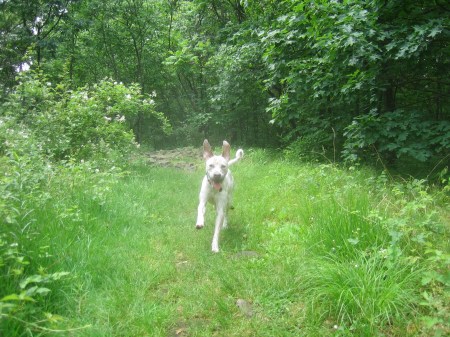
There are few things better than hiking with your dog.

Recipe: Drop dog in woods.  Walk.  Experience dog’s contagious joy.

Bending the Rules

POOPED DOG OWNERS TO GET A REPRIEVE                              For Immediate Release
Breakthrough research changes puppy raising.

Genetic engineering has produced another breakthrough discovery for dog owners worldwide.  The team of scientists who brought you non-shedding, hypoallergenic Labradoodles has successfully bred the first litter of No-Doodles, a new breed that doesn’t need to defecate. “We were getting a lot of calls from dog lovers who felt the whole dog experience was great, except for the pooping,” said lead scientist Peter Squat.  Squat owns 5 of the new breed, and no poop bags. “We’ve been working on this for years,” Squat went on to say, “We thought we had it solved when we successfully bred a dog that picked up its own poop. But, a flaw was revealed in the genetic code which caused the dogs to throw the poop at their owner, rather than in the garbage. That failed user testing.”

"Now I can go paper instead of plastic at the supermarket," said environmentalist Kale Granola.

With the foolproof No-Doodles breeding program now in place, pet industry leaders are excited about the early buzz coming from dog lovers.  “I’m going to get one as soon as possible,” exclaimed dog owner Neal Never who is known around his neighborhood as the “sidewalk miner,” “laziest guy I’ve ever met,” and “someone who deserves to step in his own dog’s poo while barefoot.”

~

Note from CATCH: Having a good sense of humor is great for your mental health and makes classes more fun for your clients.  Here’s to taking some time out for a smile and to not taking ourselves too seriously. Happy training!

Do You Trust Your Dog Off Leash?

Scientific Training Concepts Made Simple

Note for aspiring dog trainers: The below article by CATCH was originally written for NYC Central Park’s eBarker Magazine.  As you read it, note the use of many key “learning theory” concepts, such as reinforcement schedules, deprivation, desensitization, and raising criteria.  This is a great example of turning scientific training concepts into simple methods that everyday dog owners can understand and use.

Imagine you are bringing your new puppy…

to Central Park for his first ever play date during off-leash hours.  As you walk your pup towards a group of frolicking hounds, he is pulling at the leash like crazy to get to the other dogs.  He is choking himself and yanking your shoulder out of the socket.  You want to let him play off leash, but you’ve never done that before.  Will he come back?  Is this safe?

If you want to let your dog off leash, or if you ever drop your leash by mistake – you can’t be totally comfortable without knowing that he will come when called.  In the world of dog training we call this a “recall,” and a reliable one is nothing to sneeze at (or lift your leg at).

The number one reason people cherish a reliable recall is for safety.  If your dog will come every time, you can get her out of any trouble.  The nightmare scenarios for off-leash dogs in the park are plentiful.  For dog owners, they range from total embarrassment (stealing sandwiches from kids, knocking down the elderly) to annoyance (playing keep away when you reach for the collar, obsessively chasing squirrels) to gut wrenching fear (running straight for the road, lunging into the middle of a dog fight).  All good reasons to start working on that recall again, wouldn’t you say?

The good news is that most dogs can be trained to come happily when called.  I’ll give you a simple method that anyone can use and is fun for both you and your dog.  The secret to all good training is motivation – so let’s start there.  Most dogs are highly motivated by food.  There will be a few dogs in the minority on this, but if you use really special food rewards, you can teach most dogs just about anything.  My trick is to start with boiled chicken or cheese.  The former is irresistible; the latter is too, but with the added benefit that it’s easy to deal with (think pre-packaged American slices right from the fridge into your pocket).  “Sharing” food with your dog wisely and selectively (without mindlessly over-doing it) is not only a great training technique, it is a natural part of a great relationship.  Think about how food is an integral part of many love relationships – your mom’s home cooking, dinners with romantic partners, breakfasts with your kids.

To get the most power out of food as a reward, the best time to use it is… yes, you guessed it – when your dog is hungry.  This increases the value of the reward dramatically.  When training my own dogs to come, I go to the park in the morning having skipped breakfast (the dog’s, not mine – I love a good breakfast).  I bring my pup on a long line (a retractable leash will do nicely) and every time she responds to her recall command (“Here!”) by turning to look at me, I praise her and give her a piece of chicken or cheese.  I do this about 5 or 10 times spread out over the course of a long walk.

Once she’s got the hang of it, I’ll wait until she’s a little distracted by sniffing the grass, or watching another dog, and then I call her. (I’m gradually raising the level of difficulty by waiting for her to be distracted now.)  By the way, the reason I suggest using a command like “Here” is because most owners habituate (or desensitize) their dogs to the common word “Come” by over-using it without rewarding it consistently.  Once your dog is desensitized to a word, it’s useless to try and use it as a training command, so start with a fresh word when you begin this training.

After a few days of 5-10 recalls with rewards on each walk, my dog will run to me at light speed every time she hears the command “Here!”  Up to this point I have given her a reward each and every time she comes.  But, now that she’s got it down I will switch to what I call random rewards, which is where I reward most of the time, instead of all the time.  In the coming days, as she continues to show that she “gets it,” I will switch to rewarding about half the time, and eventually to just occasional rewards (this does not have to be exact, the more random the better).  The random rewards technique is powerful in making behaviors likely to repeat.  (Think about people in casinos at slot machines – winning big every once in a while makes the behavior addictive.)

Once I’m confident my dog has a reliable recall, I can trust her off leash.  Away she goes!  What a pleasure for both of us.  Over time, I will keep my dog’s recall sharp by delivering very high value food rewards only occasionally.  To keep it fun and interesting, I will mix in other rewards, too. Sometimes when she comes, she gets a game of tug with a nearby stick, or another time a game of chasing me, or I might suddenly pull her favorite squeaker ball out of my pocket and throw it for her. Of course, she always loves a stinky, delicious treat mixed in.  Be creative, have fun with it.  That’s what great relationships are about – having fun together.

What has started out as a training exercise has now become the expression of a beautiful bond.  My dog likes to be around me, she wants to go where I go, she likes to keep an eye on me, to come check in, she loves the sound of my voice calling out to her…  Oh yeah, and it doesn’t hurt that I spent those early training days using boiled chicken.  ; )  Just like those of us who were lucky enough to be rewarded by mom’s amazing meals during childhood – food used the right way can create a strong bond with very positive memories.

Why Does My Dog Ignore Me?

Why do some dogs ignore their owners daily…

but then seem to bond with a skilled dog trainer in seconds, and listen attentively to that trainer forever?

Hint: It’s a matter of repetition, but not the kind you might think.

"You called? I'm listening!" Attention and eye contact like this are a rare experience for many dog owners unless it's dinner time.

Repetition can be a bad thing.  Many dog owners accidentally teach their dogs to ignore the most important cues they want their dogs to listen to! This will happen when you repeat the same communication over and over, without any specific consequence attached.  The science of how the brain works tells us that when a signal is repeated over and over with no meaning attached – it will become background noise.  Here’s an example I always give when teaching dog training classes in NYC: If you live in a city apartment, you pay no attention to wailing sirens that pass by your window every day.  If you just moved here from a rural environment then maybe you notice them for the first few days.  But after that, you’ve heard them so much – with no consequence to you personally – that your brain literally “tunes them out”.  Don’t become a wailing siren to your dog!

A classic example of repetition without meaning…

is experienced by many dogs when they are called to Come by command, or by name.  Let’s look at some common ways that owners inadvertently teach their dogs to ignore their name:

  • Your command is repeated over and over when the dog is more motivated by something else (e.g., squirrels) and would never possibly listen
  • Your dog comes running when called but the behavior never leads to anything rewarding (no consequence)
  • Your dog runs back to you and then gets punished (you immediately put on the leash and go home – wrong consequence!)
Another common example of a word that gets ignored is “No”.  Let’s look at the ways that repeating this word turns it into background noise:
  • You say “no” over and over while you let a puppy continue to bite your hand or play tug with a pair of pants (while you’re wearing them)
  • You say “no” while you chase a dog all over the house after he’s stolen something (you’re actually turning “no” into a game)

Most dog owners mean well, but they just don’t realize that…

in order for their communication to take on meaning to the dog, they must show the dog that words and body language consistently have the same meaning.  For the coming when called example above, when you use a recall word and the dog comes, make it rewarding!  Just as important, do not use the recall word over and over – if the dog ignores you – STOP repeating the command.  Same goes for “No.”  If you say “No” you have to make sure what happens next is not a continuation of fun.  You need NOT punish your dog harshly, but consistently giving a time out or taking away the object of “puppy sin” (your hand, your pants) would go a long way towards explaining the meaning of “No”.  Timing is also very important, but that’s a whole ‘nother discussion.


Why do dogs pay close attention to trainers right away?

As a private lessons trainer, I have gone into many homes where the dogs have completely tuned their owners out.  The owner will say, “he doesn’t listen to anyone.”  But, then the dog and I hit it off very quickly.  Dogs can quickly size up a person and when they see that trainers are clear and consistent in their communication they love it!  Imagine if you were at a huge party full of people that spoke a different language from you.  Everyone you tried to talk to looks at you funny and says some jibberish back.  Then, all of a sudden you find someone who speaks your language.  Would you want to talk to him?  That’s how dogs feel when they meet a trainer.  “Thank goodness!  Party time!”

Is this magic?  No.  It can be boiled down to good communication.  Compared to a typical dog owner, a good trainer won’t repeat cues.  We will say it once or twice and then look for understanding before “wasting” the cue again.  Trainers also attach consistent consequences to their communication, with excellent timing.  Trainers say something, then watch the dog, and then respond accordingly.  Or if they want to “explain” what a word means right away, they will act on it right after saying it.  For example, if a dog is about to pick up a saucy knife I just dropped on the floor, I might say “No!” and step quickly into his space with a body block.  This “explains” what No means.  Compare that to a sing-songy sequence of “Noo”, “Nooo”, “Nooooo”, that I hear many new puppy owners chant to their pup as she chews their hands off.  I call this the No Song.  Don’t sing the No Song!

The Wrap:  Here’s how you “talk dog” like a trainer:  Don’t repeat words over and over. Attach consequences to your communication (rewards or penalties, mostly rewards).  Use good timing.  Be consistent.

~

If this post sparks questions for you, post them on our Facebook page.  We’d be happy to hear from you and answer your questions!

Like us on Facebook
Follow us on Twitter
Can’t get enough of learning about dogs?  Check Out Our School for Aspiring Dog Trainers
Would You Let Your Dog Play with a Wild Bear?

Is this fun – or a path to doggy death?

Check out this video from FirstScience.tv – then we’ll talk about body language.

What is the first thing you notice that shows there is no conflict in this encounter between the dog and the bear?

  • Both animals turn to the side, they are not “facing off”
  • Their body movements are loose and fluid, not tense and stiff

These are the same body language signals you might see in a peaceful encounter between greeting dogs!

What is the next incredible display of restraint that you notice?

  • The bite inhibition of the bear!

The bear has his jaws wrapped around the dog’s head and neck.  He could crush the dog’s skull in one bite.  But he doesn’t – he shows amazing bite inhibition (careful control over his jaw muscles).  Wow.  Dogs also must have great bite inhibition with one another in order to be good playmates.  They learn this with their littermates at a very young age.  Bite too hard, and your puppy playmate will yelp and withdraw, ending the fun.  Clearly, bears develop bite inhibition naturally as well.  But, to apply it to an interaction with a dog – fascinating!

Is that bear self-handicapping?

  • Yes!  This is a fancy term for when a larger, stronger animal “levels the playing field” by making himself smaller, gentler, or more vulnerable.  It is designed to keep the play going.  This bear rolls on his back to get the dog engaged in wrestling!
  • Also, look at the amazingly gentle pawing by the bear.  What a beautiful way to initiate play.  Again – very similar to dogs.  You’ve seen dogs do that – right?

What about that bear hug – is the dog going to be crushed?

  • Another example of beautiful restraint, notice how comfortable the dog is when being wrapped in the bear’s gigantic arms.
  • There is one moment where the dog’s mouth gets tense and then he “corrects” the bear with a little air snap.  This appears to work as the bear does not keep his grip too tight.
  • On the whole, the dog does not try to get away – he seems to really enjoy it!  His eyes are not tense, his mouth is open, relaxed and loose.  His ears are not back in fear at all!

Many parts of the interactions you see here can be seen in good dog play, too!

  • Smooth, loose movements (not stiff and tense)
  • Good spacing between the animals, with pauses in the action
  • Bite inhibition
  • Awareness and control of their bodies so as not to overwhelm their playmate
  • Both animals are willing participants
All we can say is wow.  See if you can spot these tell-tale signs of play next time you are watching your own dog!

Puppy Magic – from Petrified to Playmania

Social Butterflies

"I used to hide behind chairs, but now I hunt Poodles for a living."

Most dog trainers would agree one of the most satisfying sights in a puppy kindergarten class is seeing shy dogs gradually gain confidence each week until they finally burst out and play like maniacs with the other pups.  If you think trainers get excited over this, you should see the owners when their fearful fidos turn into wild players.  Tears of joy are not uncommon.  If you’ve experienced this with your own dog, you know just what I mean.

How do I know if a pup will come out of her shell?

If a shy pup is still in her critical socialization period (before 12 weeks of age), the chances of her building confidence in a well-matched play group is very good. The younger, the better. Let’s look at two wonderful puppy kindergarten graduates as an example.  Meet Coco the Maltese and Brady the Poodle.

Clash of the Titans

What was the best part of class for these two tiny tots? It was the socialization. Sometimes you get pups that are just a wonderful match for bringing one another out of their shell. These two dogs started out shy and gradually became increasingly confident, especially with each other.  Each week they tried a little something new – a sniff here, a pounce there – until they were chasing and wrestling like wildfire – and loving every minute of it.

The trick now for their owners is to keep socializing.  Too many owners take it for granted that socialization with one other dog is enough.  Imagine if you only interacted with ONE other human until you were 3 years old.  Think you would have some awkward social mannerisms?  Of course.  Let’s look at this situation with dogs…

The Myth: Socializing your pup with one or two other dogs is enough to make her comfortable and socially normal with almost all dogs. (I get this all the time from owners who tell me they don’t need to socialize their pup with other dogs because they already have another dog at home who they get along with just fine.)  This is short-sighted and puts a dog at high-risk for having very limited social capabilities.

The Real Deal: Just because your dog interacts well with one or two other dogs does NOT mean they will be comfortable around other dogs of different sizes, ages, and breed types. Diversify your pup’s socialization experiences with as many other dogs as possible, as long as the setting, size match-ups and play styles are appropriate. Make sure the experiences are positive (or at least not blatantly negative). This will help you raise a “worldly” dog who can handle herself like a diplomat in many different social situations!

Enjoy these photos of Coco and Brady playing.

Brady: "Damn this girl's good. She can mirror my every move."


Brady's coming in for the pouncedown, Coco puts on the brakes.

They read each other with lightning quickness. There's Brady's takeoff for the pounce, Coco already has one foot out the door.

Air Coco: "Ha. ha. ha. We're so cute we'll never have to listen to a thing they say!"


CATCH Canine Trainers Academy Office Headquarters
24 Newark Pompton Turnpike Suite 206, Little Falls, NJ.
Phone: 877-752-2824