CATCH Canine Trainers Academy Blog

Why is THAT the Puppy I WANT!?

What does my Dog Choice Mean for my Life?

Cattle Dog

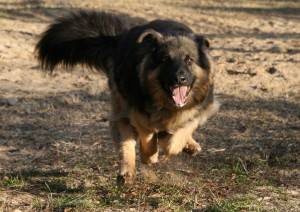
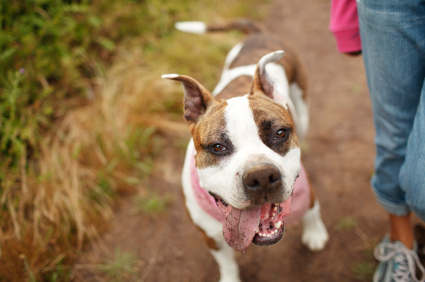
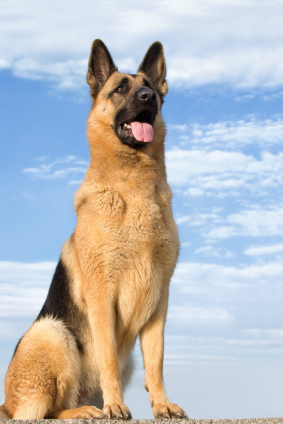
Why do we choose the dogs we do? Whether you’re a dog owner, a trainer, or a rescue worker, it’s valuable to understand this. There IS one moment when you choose the dog you will spend years with. What made YOU pick out the dog that you have now? Was it the black splotch over his eye? Was it the fact that she looked just like the last dog you had? How about that it had to be a boy, and this was the last boy in the litter? Or was it that you’ve always had Golden Retrievers and wanted another, and it had to be cream colored, too?

It’s no secret that most of us pick our dogs based on looks.

As humans, we are highly visual, and we base a lot of decisions on the way things look. Sometimes it works out for us, and sometimes it doesn’t. Just because a dog is gorgeous doesn’t mean he will be well behaved. Just ask show dog owners. Their confident, energetic dogs are notorious for naughtiness.

What about breed bias?

Most of us have a breed preference, or at least a size preference. Maybe we only want “real” dogs and that means they have to be over 50, or 60, or 100 pounds! Or maybe your version of a “real” dog is one you can pick up, snuggle into your cheek, and share your pillow with.

There are practical limitations. Many of us are limited by the rules of our landlord or community. Perhaps your choices are restricted by your allergies (hypoallergenic doodle, anyone?).

Looks and limitations aside, we have to be careful to judge every dog as an individual.

PugChoosing a dog based on her personality (behavioral tendencies) is a rare thing, even among knowledgeable, educated dog professionals. Putting personality over looks takes a certain wisdom (usually acquired after owning a dog or two) and those who do it reap the rewards. If you want to find a personality that will compliment your life (instead of complicate it), be honest about your lifestyle and the kind of dog that fits into it. If you’re an athlete who likes to spend lots of time exercising with your dog, or you want to teach her tons of tricks, a sporting or herding breed will probably be great for you. But, will she still be a great choice in a few years, if you get married, have children, or get promoted at work? Only if you still carve out the time for her.

You can always find a few sporting or herding dog individuals that have minimal exercise needs.

But, that doesn’t fit with the average for these breeds. A rare, calm example of an active breed can still be great for you if you get married, have a few children, and get promoted. But, it’s unlikely that you’ll find her if you choose based on looks alone!

Whether you are getting a puppy from a breeder or adopting an adult from a shelter, no one ignores looks completely. After all, we live with dogs to enjoy having a beautiful animal brighten up our living rooms, bedrooms, and yards every day. Our advice is to keep looks near the top of your list, but make sure you prioritize behavioral tendencies, and the dog’s likelihood to fit into your lifestyle. Your long-term relationship will succeed when you choose the dog whose behavior suits you most.  Besides, after a while, no matter which dog you have, you’ll think she’s the cutest thing on four legs!

For more on How to Choose a Great Dog for You, read the article by the same name found here.

How can a Dog Lover Make a Difference?

Don’t Dog it – Get Involved in Your Community!

We are proud that so many of our students are helping dogs and dog owners in their community every day. The funny thing is, as a dog lover, we know you wouldn’t have it any other way. You might say the time you spend with dogs is actually selfish because you love it and it’s good for you. So be it – a classic win-win!

Even if you’re not a student yet, here are some great ways you can satisfy your craving to spend time with dogs, learn more about them, and help them at the same time. We’ve categorized these by your skill level.  Whether you are inexperienced or a pro, there’s plenty of ways you can make a difference and immerse yourself in the joys of dog companionship.

Category 1 – Just a Dog Lovin’ Fool (Little to No Behavior Knowledge)

  • Take a rescue for a walk!

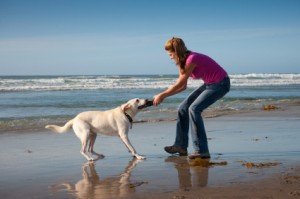
    Take a rescue for a walk!

    Volunteer to help out at the local shelter – cleaning, walking, prepping food toys, spending time with dogs that need companionship

  • Foster a dog from a local rescue
  • Train your dog to be a therapy dog and take her to meet people who could use a furry friend
  • Offer to exercise your neighbor’s dog (you know, the one that sits home all day with nothing to do)

Category 2 – Student of Training & Behavior or Dog Lover with Ownership/Training Experience

  • Training manners is always a win-win.

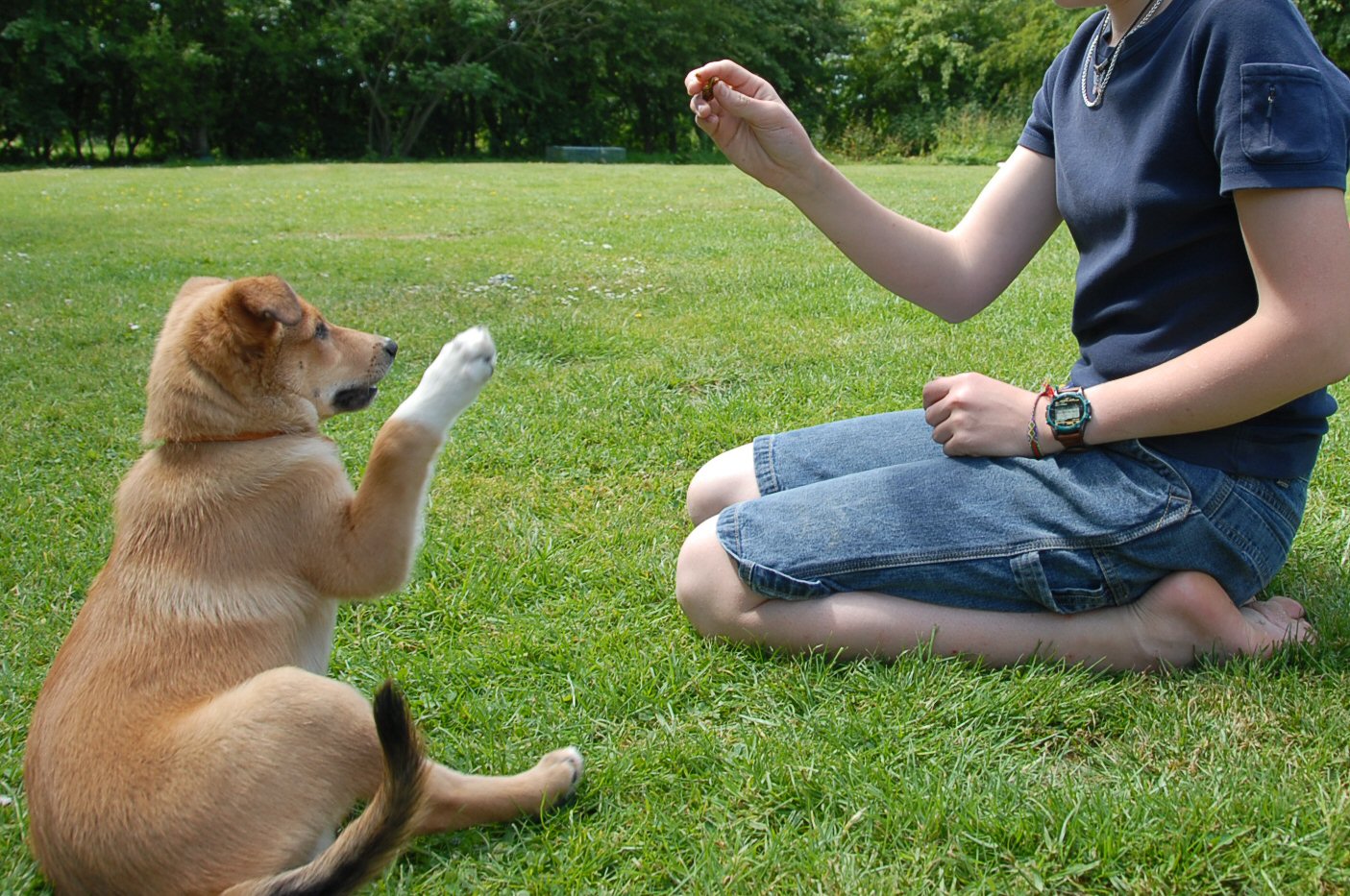
    Training manners is always a win-win.

    Volunteer to help out at the local shelter – walking, training, assisting in behavior evaluations

  • Foster a more challenging dog from the local shelter
  • Volunteer to answer the phone for a local rescue group’s behavior hotline, helping new adopters and foster parents to resolve training and behavior challenges
  • Offer to train your neighbor’s dog (you know, the one who is clearly smarter than he lets on (the dog, not the neighbor))
  • Become an assistant in a professional trainer’s classes

Happy training! Let us know how it goes for you and get in touch if you’re serious about learning more.

How Do I Train a Dominant Dog?

Alpha-Shmalpha?

No topic gets more muddled by myths than dominance. I recently had two different students ask me how to deal with a dominant dog because an established person in the field gave them questionable advice. One was advised by her vet that, “she better be alpha” and yell at her dog more to get training results. Another student was advised by a trainer that, “you must train commands without food in order to get the dog’s respect.” Are these accurate statements? Should you use different training techniques with a dominant dog?

Defining dominance

"I'm a proud, dominant dog, but also a good girl!"

“I’m a proud, dominant dog, but also a good girl!”

For this discussion we will define a dominant dog as a confident personality type that prefers to be in control of situations and resources. This does not mean the dog is aggressive, it just means she prefers to control resources and make her own decisions rather than give up control and take direction from others. The opposite of this is a submissive-type dog that is happy to let others be in control and take resources from him at any time. The submissive-type dog readily responds to direction from others.

How does a dog get to be dominant?

A dominant dog may be that way by genetics (natural personality) and may also learn dominant behaviors based on what she was able to do with the other dogs or humans she grew up with. As you learn in our course, you cannot separate the nature (genetics) from the nurture (learned behaviors). Dominance would not come from poor socialization, but could come from a certain type of social environment (where the dog learns to be the boss and control resources).

Can I use reward-based training with a dominant dog?

Of course! I would train a dominant dog using reward-based techniques (including food), but I would never neglect good leadership and good handling. Good leadership means being consistent in your communication and rules. It means you don’t spoil the dog by giving everything away for free, but that you control rewards and give them out for great behavior. You set up situations so that the dog learns to see that “the best things in life happen to me when I am paying attention, exhibiting self-control, and showing good manners.” The dog must also learn that “no fun ever comes as a result of me being pushy or out-of-control.” When you are consistent with these rules, and sound in your handling techniques, even a dominant dog will respect you.

Good handling is using your body and/or leash to keep your dog under control and manage the physical space she occupies. In dog training speak, how well you “handle” dogs is a direct reflection of whether or not you are in control of the dog. Good handlers are well appreciated all over the dog world: in training, shelters, day care, vet offices, grooming, and public. Poor handlers have dogs “walk all over them” – literally and figuratively.

The relationship factor

The first key to training any personality is to find out their biggest motivators and use them as rewards. But, if you’re talking about training a dog to be a well-behaved family member (as opposed to just perform a set of obedience commands) then the RELATIONSHIP becomes a big factor. With a dominant dog, you have to be strict in the everyday interactions that form your relationship because if you give an inch she may take a mile. This simply means you stick to the leadership rules I described above. In other words, there are some “easy” submissive-type dogs that will be well-behaved even if you spoil them and let them walk all over you. But, with a dominant personality, more than other types, you may pay the price for poor leadership. Leadership, of course, should never be harmful, but it may have to be strict and should always be consistent.

Teach me more!

Don’t Get Stuck on Food (Part 2)

Take the “Bribe” Out of the Equation

As we reviewed in our last post, getting behaviors without showing food first is called fading a lure and it is something you must learn!

Fading a lure can be achieved in 5 steps. Skilled trainers adapt these steps to match the individual dog’s training progress, but once you get these basics down, you’ll get the most out of food – nature’s most powerful motivator since sex!  

Read on for the last 2 steps plus an overall summary. (For steps 1 – 3 in our last post, click here.)

4. Use life rewards, delayed rewards  and hidden rewards

Once a behavior is well-trained, you can reward in so many ways. Got stick? If so, tug is a reward!

Once a behavior is well-trained, you can reward in so many ways. Got stick? If so, tug is a reward!

Once your dog performs a behavior consistently (in training we call it being fluent in a behavior), there are ways you can reward a dog without showing him the food first. Rewards keep behaviors strong, but you don’t have to bribe the dog by showing him what’s in the offing before he performs. Let’s look at each reward type listed above:

Life rewards are activities your dog loves, such as door-opening privileges, getting a ball thrown, access to play with other dogs, etc.

Delayed rewards are rewards that come several seconds or more after the behavior is performed. A common example is when your dog responds to a recall by running back into the house. You might then run to the kitchen together where you open the fridge and reward him with a piece of cheese. Use praise to bridge the time gap.

Hidden rewards are those that your dog didn’t realize were there – a surprise (which is powerfully rewarding in itself). Before a training or proofing session, you can pre-hide rewards anywhere:  a drawer, a tree branch, an inside pocket – just make sure your dog doesn’t see or smell them before you reward him.

5. Practice in new areas

To put the finishing touches on a behavior you have to generalize it, which means teaching the dog to perform it in many different situations.  Practice in a few different places (various rooms of your house, the yard, the street, the park, etc.). Make it easy for the dog by going back to step 1 of luring whenever you add a level of distraction (new situation or environment). Doing a recall or a stay at home is nothing like getting it done at the dog park! You have to be willing to be more generous with rewards in distracting situations. In other words, take a couple of steps back to get the behavior fluent in the new place, then you can start fading the lure out again relatively quickly.

The Wrap

Once you have these 5 steps going, gradually switch from rewarding all instances of a behavior, to most, to a random few. If you don’t do this gradually, the dog will lose interest. Picture yourself in a casino playing a slot machine, where you win every time you play. If all of a sudden you completely stop winning, you’ll get up and leave that machine for sure. This is what happens to our dogs when all of a sudden, we stop rewarding completely. Instead, shift to random rewards gradually. When you turn yourself into an unpredictable slot machine that sometimes pays big, your dog will become addicted to the game.

Love Learning about Dogs? Let’s Make it Official.

Don’t Get Stuck on Food – 5 Simple Steps

No Trick (if) No Treat!

In the world of human relationships, food “sets the table” for shared fun and positive memories. From first dates to 50th anniversaries, good food plays an integral role. As funny as it may sound, it’s no different in dog training – food makes things happen and keeps dogs “remembering the good times”! Pro animal trainers all over the world know that delicious treats are one of the most powerful tools for teaching new behaviors that stick. But, alas, there’s a catch! Beginner trainers can get stuck on food themselves. You don’t want to end up with a dog that only listens if you show him food before every request. Getting behaviors without showing food first is called fading a lure and it is something you must learn!

You can train all kinds of behaviors with food lures from fun tricks to serious search and rescue.

You can train all kinds of behaviors with food lures, from fun tricks to serious search and rescue.

Luckily, fading a lure can be achieved in 5 simple steps. Skilled trainers adapt these steps to match the individual dog’s training progress, but once you get these basics down, you’ll get the most out of food – nature’s most powerful motivator since sex!

1. Lure for what you want

Use a smelly, tasty treat to get the dog’s attention, then move the treat to lure the dog into the position you are looking for. For example, to teach a Sit you move the lure from the dog’s nose upwards and backwards so that as he looks up, his butt goes down.
When luring, the treat serves two purposes: the first is to gain the dog’s focus and the second is to guide the dog into position.

2. Use the hand signal, empty-handed

Once your dog is consistently following the lure in your “signaling hand” and moving into the desired position each time, put the food in your other hand. Now, move your signaling hand without the lure in the same exact way that you had been doing with the lure. If the dog is “patterned” from “getting paid,” then he should at least try to follow the hand into position again. If he does, pay it BIG! If he doesn’t, try again or go back a step to re-establish the pattern.

3. Feed from your other hand every time

Continue to give the dog your hand signal now without the lure in the signaling hand. Give the treat from your other hand, which you keep at your side or behind your back until the behavior is performed. Every time your dog moves into position, pay him instantly and pay him well!

Challenge Yourself:  Use the steps above to teach your dog 3 behaviors (ex., Sit, Down, Hand Target) fluently – without having a lure in your signaling hand.  Then, in our next newsletter, we’ll teach you how to completely fade the food with the last two steps, plus how to make your training stick with the powerful concept of random rewards. Stay tuned!

Build a Thriving Dog Business

Announcing dog*tec Discounts

For an animal lover, there’s nothing better than a successful career with dogs.

We’re excited to announce another great advantage for CATCH students! We’ve teamed up with dog*tec, the industry’s leading business support company, to arrange generous discounts – just for CATCH enrollees and grads. When it’s time to start your business, or push it forward, we recommend taking a look at dog*tec services and products – it’s a great way to get ahead, with experts on your side!

We are thrilled to bring you this partnership because our team has always been impressed with the high quality of dog*tec offerings. Whether you are an existing student with us, or you plan to be in the future, you will get to take advantage of all the following:

Consulting Services

Take advantage of dog*tec’s one-on-one business support:
$500 for a 5 hour Start Up Package (regularly $550)
$900 for a 10 hour Start Up Package (regularly $1,000)

Business Products

dog*tec is offering CATCH students a $100 credit to spend on any of their business products (excluding books & DVDs)!
Choose from:

If you’re just getting started, consider spending your $100 on one of dog*tec’s Business Success Packages as a way to save even more.

With top notch courses and connections, CATCH will fuel your success in dog training and behavior!

Call Student Support to find out how we can help you Launch Your Dream Career.
877.752.2824 (877.75.CATCH)
studentsupport@catchdogtrainers.com

Let the Dogs Work it Out?

What is Your Dog’s Play Persona?
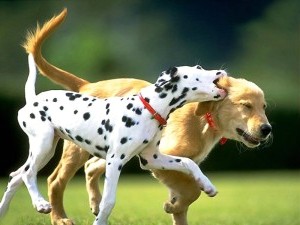
Soft, squinty eyes and bouncy, light-stepping paws tell you that this is not a serious bite.

Picture dogs in a dog park or similar “play” setting. The dog owners are there, some are even paying attention (wink). But, do they know what they are watching? With this question in mind, we recently attended a seminar where we learned about an iPhone app called Dog Park Assistant by renowned dog behavior expert, Sue Sternberg. The Dog Park Assistant app helps owners understand their dog’s “play personality” and shows them how to keep their dog safe by understanding signals that often go unnoticed. The app has prompted interesting discussion among trainers and owners alike.

Let’s see if you are realistic about your dog’s play persona. Then, let’s test your ability to read dog body language.

Most dog owners…

…have a sense for what their dogs are “saying” with their body language (but not a strong understanding.)

…watch dogs play rough and say, “it’s fine – just let them work it out.” (But, something inside them says, “should I?”)

…mean well, but don’t always do well by their dogs.

Experienced, well-studied dog trainers can help non-expert dog owners understand their dog’s body language better and teach them when/how to keep their dog out of trouble. What’s trouble, you ask? For the purposes of keeping it simple, let’s say trouble is your dog becoming distressed or your dog causing another dog to become distressed. In the best case scenario, a distressed dog is scared for a moment and then gets comfortable by moving away or when someone else intervenes. In the worst case scenario, a dog is injured or a young pup has their social outlook damaged for life. Not cool.

We often post GUESS THE BEHAVIOR CHALLENGES on our Facebook page and they lead to fascinating discussions about what’s happening between the dogs.  Let’s look at a recent post and…

Test Your Skills at Reading Body Language
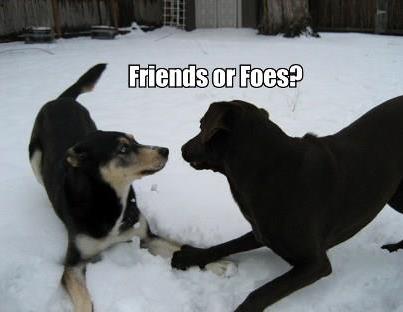
What do you see here that makes you comfortable?  Anything make you uncomfortable?  Take a moment to review the photo carefully, then look at our answers below.

If you said these dogs are playing – you are right – for the moment. You can see a wag on the left dog and both dogs are in a classic play bow position with butts up and front ends down.

But, is there cause for concern? Yes, some. The dog on the left looks a little bit uneasy. She is leaning back, her ears are pinned back (showing fear), her eyes are wide, and her lips are tensely pulled forward.

The dog on the right is assertive, with his paw on top, a forward lunge, and his muzzle right in her face. You can never tell everything in one snapshot – but, you can learn a lot and train your eyes to see key signals. Would you be surprised if the dog on the left ended up on the receiving end of a bullying session? We wouldn’t.

One sign of good play is if both dogs are willing participants. That’s something we would want to see here to be truly comfortable – both dogs continuing to come back for more. Other great signs would be lots of goofy play bows continuing throughout the interaction, with both dogs giving each other plenty of space as the wrestling and chasing carries on. Sometimes you will see interactions start as play and then tip over into something less fun, more serious. When the movements stop becoming goofy and bouncy – pay closer attention and interrupt as needed.

Learning to read dog body language takes time, but boy is it fascinating. You get better with education and practice. In CATCH classes, we study a lot of photos, videos, and live interactions to build skills.  Having the Dog Park Assistant in your pocket won’t hurt either – check it out!
How to Make a Dog Lover Happy

Woof! Refer-A-Friend


We Have Something to Bark About
Know anyone who wants to learn more about dog behavior and training?  If so, we are teaming up with Amazon.com to give you and your friend a cash gift!
Here’s how it works:  Tell a friend about CATCH and if they enroll in any course, you will both INSTANTLY be emailed a gift certificate from Amazon.com.

  • If your referral signs up for the Master Class program with Mentor – YOU WILL BOTH GET a $100 GIFT CERTIFICATE EMAILED TO YOU INSTANTLY!!!  (Yes, you both get one hundred dollars.)
  •  If your referral enrolls in any other course – you will both get a $25 gift certificate emailed to you instantly.

The Gift Certificate code can be used on Amazon the moment you receive it by email.  And in case you didn’t already know, Amazon will ship almost anything in the world to your home.  From clothes to electronics – get something awesome for yourself.  You deserve it.

“I’m gifted. Why shouldn’t you be, too?”

It’s our way of saying Thanks for spreading the word.
CATCH a friend & get gifted!

Call us anytime to enroll or give the name of your referral:
877-752-2824 (877-75-CATCH)
studentsupport@catchdogtrainers.com

Get Magic Out of Mealtime

Food in a Bowl Can Be So Much More

Some dogs eat so fast that when they’re done they look at you and say, “You kidding me? That’s it?”

Others won’t touch the food you put down because it’s SO lame for a predatory animal to eat something that just sits there.

“This meal is so lame I can sleep in it.”

The Myth: Feeding is feeding.  Just give the dog a meal – she’ll eat, drink, and be merry.

The Real Deal: Mealtimes are a great opportunity to train obedience, give your dog mental exercise, build a deeper bond, satisfy hunting instincts, or increase the appetite of a dog that turns her nose up at dog food.

Saavy dog owners turn mealtimes into something special.

Here are a few easy ways you can do it:

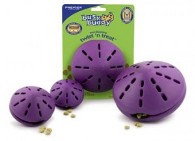
1. Ditch the food bowl.  Put the meals in a Busy Buddy or Nina Ottosson toy.  Just fill the toy with food and then your dog has to play with it to make the food fall out.  Hint: set up the toy so it’s easy at first.  Increase difficulty as your dog figures out smarter ways to dispense the food faster. Very fun to watch!

2. Scatter your dog’s food all over the backyard.  This was a favorite of my Husky-Shepherd mix, Eli.  He would hunt down every last piece of kibble.  It is amazing to see how talented dogs are with their noses.  Believe me, if your dog is into his meals, he will find every bite.  Yes, even in the uncut grass.  Like all new games, make it easy at first (just a few small piles), then increase difficulty (scatter!).

3. Check out the Eat Slow Bowl This will make meals last longer.  More fun for the dog and also safer for dogs that are prone to bloat from gobbling too much, too fast.

4. Make mealtime a training session and use the food as a reward. Teach basic obedience.  Or how about tricks? Just make it fun and interesting. Use one piece of kibble (or one lick of wet food off a spoon) as a reward for each task well done.  This practice will really enhance your bond and give your dog a chance to learn new skills.

One of Our Favorite Busy Buddy Toys, the Twist-n-Treat

The Wrap: Mealtimes are a chance for your dog to do more than just stand over a bowl.  Try the ideas above that best fit your dog and your lifestyle.  You’ll see for yourself that the increased mental exercise will make your dog happy and improve his behavior.  If he’s a really naughty pooch, at the very least he’ll be out of trouble during the time he’s eating!


Why Won’t My Dog Come?!

Unfortunately for us dog owners, coming when called is one of those behaviors that is easy to screw up.  We don’t mean to, but we do a better job of teaching our dogs to ignore us or run away than we do in training them to come!  This post is here to help you STOP the INSANITY. Especially if you have a new pup or a newly adopted young dog, following these rules can make all the difference between a dog that comes to you versus a dog that runs from you. 

Here are your indispensable, comprehensible, well-intentional…

6 Rules for Recalls

“You called? I’m back!”

1. Never call your dog to come and then have it result in something she won’t like.  (E.g., bath, nail clipping, crate time, etc.)

2. If you must expose your dog to something she won’t like – do NOT use any kind of recall cue before the unwanted event.  Just go get her instead.  Or do something fun in between!

3. During the early training phase when you are still teaching a recall, do NOT use your recall cue word UNLESS you are prepared to reward generously.

4. Do NOT use your recall word in situations where you know your dog will fail.  In other words, don’t start practicing this while your dog is in the middle of a euphoric chase with another dog or a squirrel.  You need to gradually work your way up to that level of distraction.  (If your dog hears the cue word over and over, all the while ignoring it,you will systematically desensitize her to the very word you are working hard to train.)

5. Use a SLACK long line at first when training so that if your dog ignores you, she CANNOT learn that ignoring you is more fun than listening to you.  (Example: You call your dog.  Your dog ignores you and chases a squirrel instead.  Outcome of ignoring is rewarding to her.  That’s not good for training.)

6. Reward all recalls with FUN. This could be rubs, toys, play, chase, treats, walks, more freedom, etc – be creative!  This is especially important in early training.  Once your dog KNOWS that recalls are wonderful, the association with them will be so positive that running to you on cue will be one of her absolute favorite things to do.

Have fun training!


CATCH Canine Trainers Academy Office Headquarters
24 Newark Pompton Turnpike Suite 206, Little Falls, NJ.
Phone: 877-752-2824